
Xiaomi is a global technology company known for smartphones, IoT devices, and consumer electronics. To support its internal operations, Xiaomi developed Mi Pro Work its own collaboration and communication platform. Instead of using Slack or Microsoft Teams, the company chose to build and maintain an internal system. This reflects a strategic focus on control, integration, and independence.
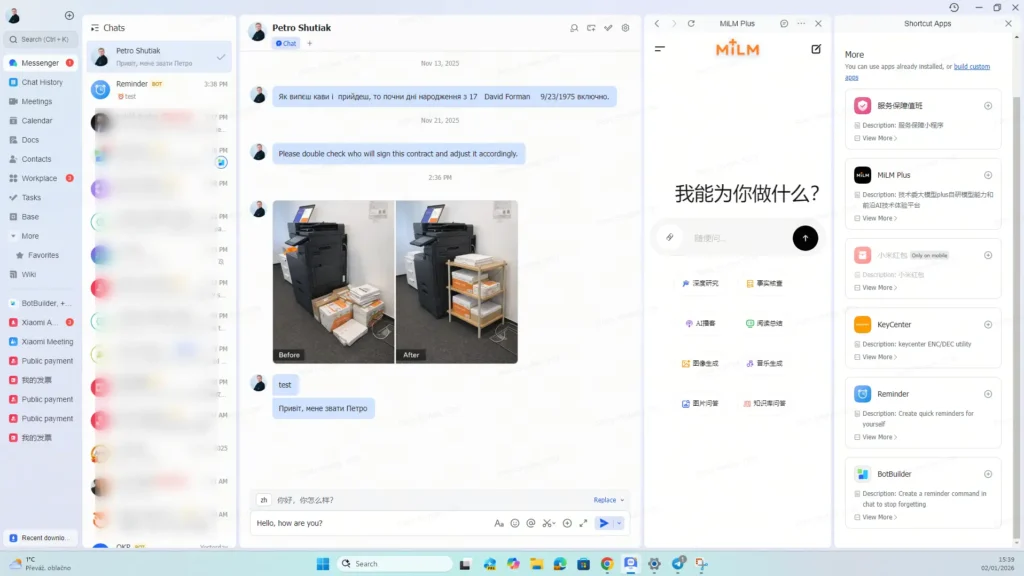
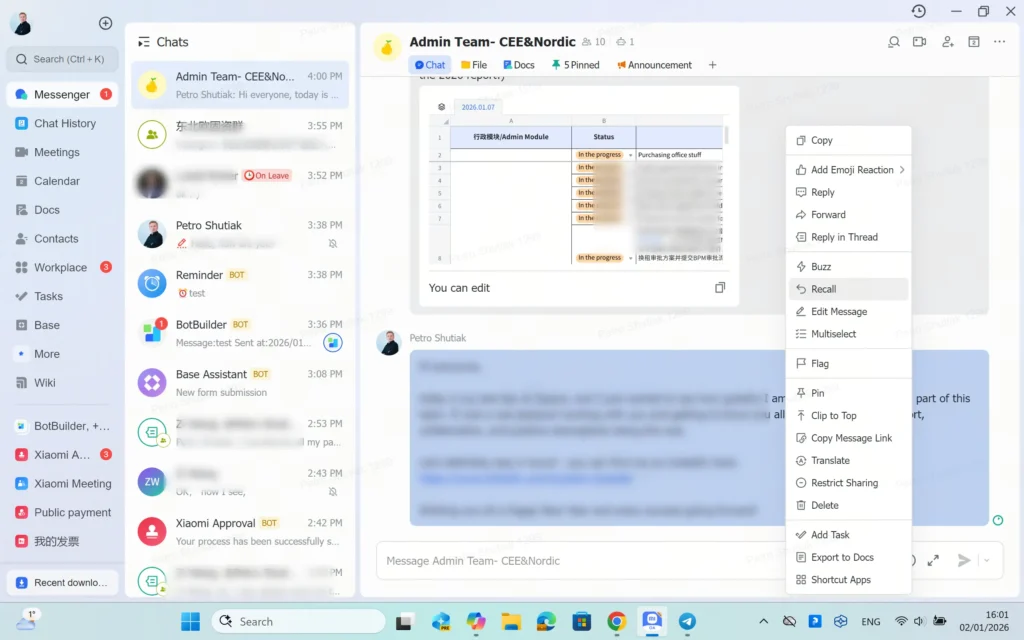
Mi Pro Work is not just a messaging tool. It combines chat, meetings, calendar, documents, tasks, mini-apps, HR workflows, and an embedded AI assistant within one interface. The goal is to reduce tool fragmentation and centralize internal processes.
Strengths
Structurally, the system appears coherent. Core modules are integrated rather than loosely connected.
Messaging supports threaded replies, editing, recall, task creation, and document export. These features enable structured communication and governance control.
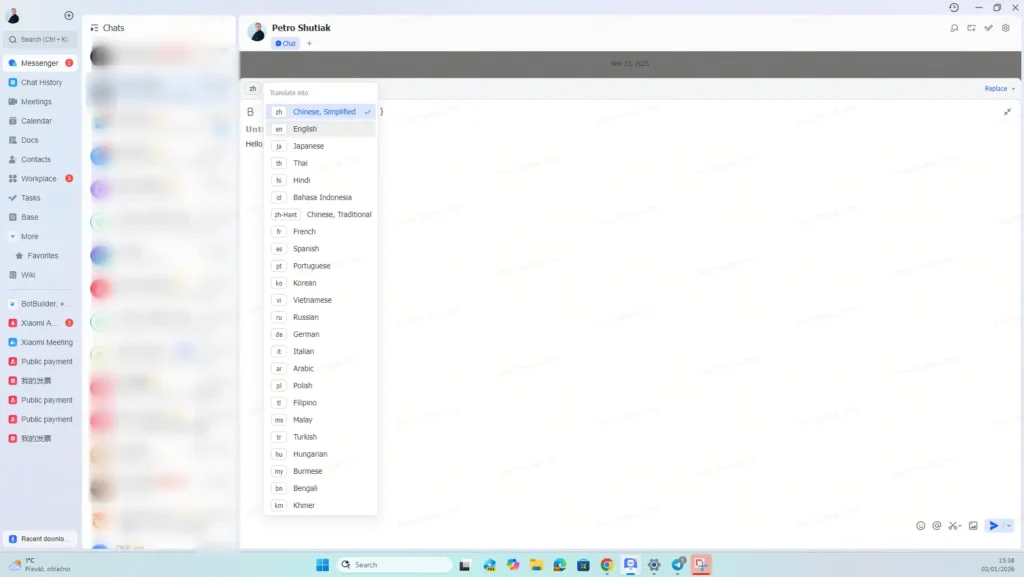
One of the strongest elements is the built-in AI translator. It works directly inside chat and allows near real-time translation across multiple languages. For a global company like Xiaomi, this reduces communication friction between international teams.
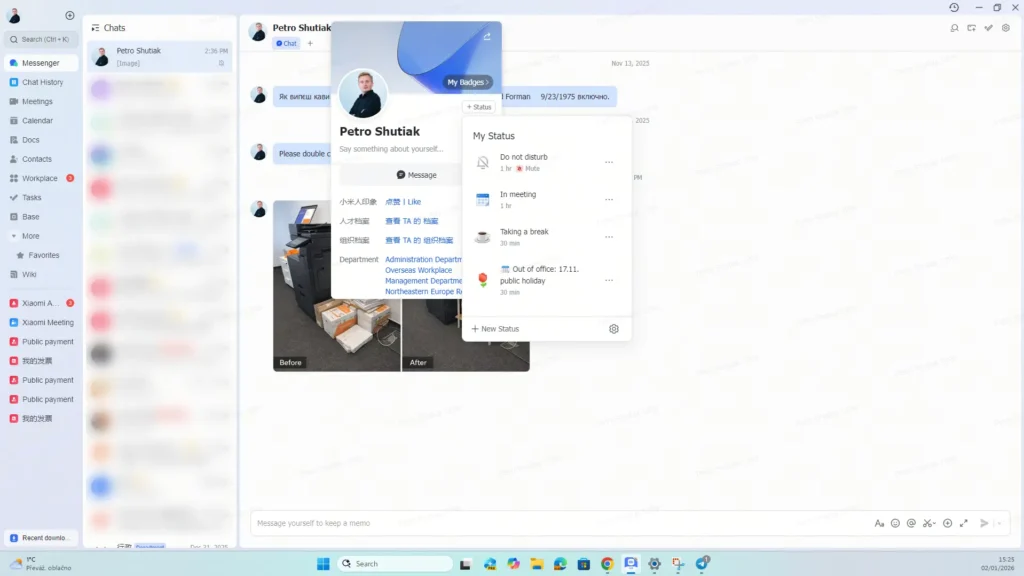
Calendar and meeting functions look native, with time zone handling and room booking integrated. HR synchronization, such as automatic status updates after vacation requests, improves system cohesion.
Overall, the platform shows strong alignment with centralized enterprise control.
Gaps Compared to Slack and Teams
The main difference is ecosystem maturity.
Slack and Microsoft Teams benefit from mature APIs, large app marketplaces, and long-term ecosystem evolution. Mi Pro Work appears more internally focused and less open for external extensions.
UI refinement also differs. Slack and Teams show higher consistency in micro-interactions and visual hierarchy. Mi Pro Work feels functional but denser.
Localization consistency is another weakness. Mixed Chinese and English interface elements increase confusion. From a QA perspective, this suggests incomplete internationalization validation across modules.
Scalability perception also matters. Slack and Teams are battle-tested at global scale. Mi Pro Work’s reliability at equivalent scale cannot be assumed without empirical evidence.
QA Perspective: Complexity and Risk
From a QA standpoint, the platform is complex by design.
Cross-module dependencies increase regression risk. Messaging connects to tasks, documents, meetings, permissions, and AI features. Shared state expands test scenarios.
Permission matrices require strict validation. Governance-heavy systems often contain rule-based defects.
Localization and inline translation expand regression coverage. Calendar logic introduces subtle edge cases, especially across time zones.
The internal mini-app ecosystem and embedded AI add further risk layers. API stability, data isolation, output consistency, and access control must be continuously monitored.
Enterprise systems require high reliability. Even minor synchronization issues can disrupt operations.
Conclusion
Mi Pro Work is not conceptually flawed. It is strategically ambitious.
Its strength lies in control, internal integration, and workflow alignment. However, compared to Slack and Microsoft Teams, it lacks visible ecosystem maturity and UI refinement.
The real challenge is not building such a platform.
The real challenge is maintaining global quality standards as system complexity grows.